

The e-commerce industry is moving toward smarter automation as businesses seek better ways to manage operations, enhance customer experiences, and scale efficiently. While Shopify has simplified the process of launching online stores, managing products, inventory, customer interactions, and daily workflows still requires significant time and resources.
The growth of AI agents for Shopify stores is changing how merchants approach online business management by helping automate repetitive tasks, analyse business data, and support faster decision-making. These intelligent systems are becoming an important part of modern Shopify operations, allowing businesses to create more efficient, adaptable, and future-ready online stores.
Table of Contents
- The Evolution of Shopify Store Management
- How AI Agents Are Transforming Shopify Store Operations
- The Role of AI Agents in Improving Customer Experience
- How AI Agents Help Shopify Businesses Scale
- Practical Examples of AI Agents in Shopify Stores
- Why Businesses Are Exploring AI-Powered E-Commerce Solutions
- The Future of Shopify Store Operations With AI
- Conclusion
The Evolution of Shopify Store Management
Why Traditional E-Commerce Operations Are Becoming More Challenging
Running an online store has become increasingly complex because customer expectations and market competition continue to grow. A Shopify merchant today needs to manage multiple areas of the business simultaneously, including:
- Product selection and optimisation
- Customer service and communication
- Inventory management
- Sales performance analysis
- Marketing and conversion improvements
For small businesses and growing brands, managing all these responsibilities manually can slow down growth. Entrepreneurs often spend more time on repetitive tasks rather than focusing on strategy, branding, and customer relationships.
AI-powered technologies help businesses overcome these challenges by introducing automated systems that support everyday operations.
The Rise of Intelligent E-Commerce Automation
Artificial intelligence is changing how online businesses approach automation. Traditional automation tools usually follow predefined instructions, while AI-powered systems can analyse information, recognise patterns, and provide more adaptive support.
The growth of AI agents for Shopify stores represents this shift toward smarter store management. These solutions help merchants improve workflows, reduce repetitive tasks, and run more efficient online retail operations.
How AI Agents Are Transforming Shopify Store Operations
Automating Repetitive Store Management Tasks
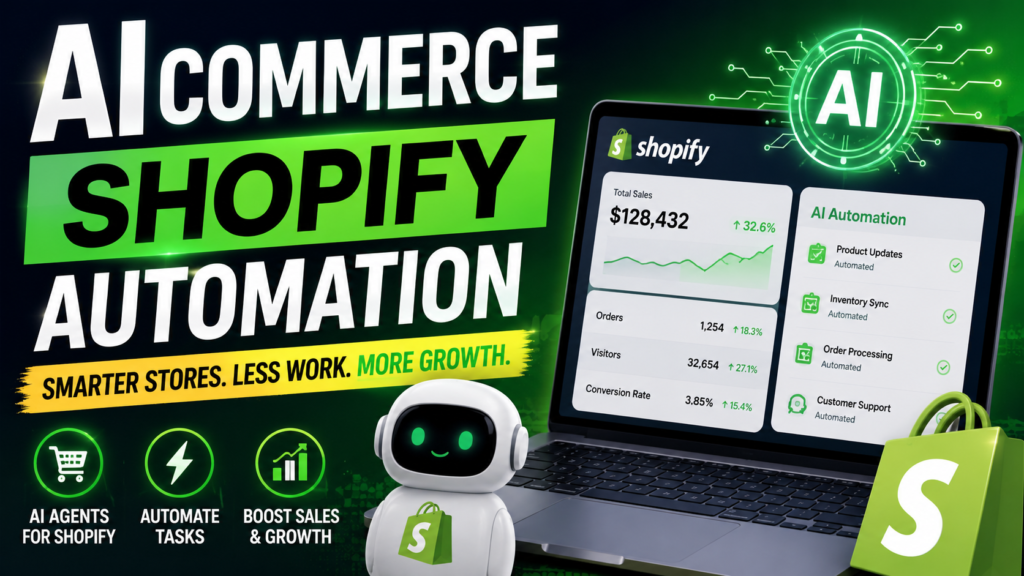
One of the biggest advantages of AI agents is their ability to handle routine activities that traditionally require significant manual effort. Various Shopify merchants can use them to support different operational areas while maintaining better efficiency.
AI agents can assist with:
- Monitoring product performance and identifying improvement opportunities
- Analysing customer behaviour and purchasing patterns
- Supporting customer enquiries and communication workflows
- Helping businesses organise daily store activities
By automating repetitive tasks, entrepreneurs can spend more time on growth strategies, product development, and improving customer experiences.
Improving Product Research and Store Optimisation
Product research is one of the most important parts of building a successful online store. Understanding customer interests, market demand, and purchasing behaviour helps businesses make stronger decisions.
AI systems can process large amounts of information and identify trends that may be difficult to discover manually. This helps merchants better understand which products attract attention and where the store needs improvement.
Instead of relying only on assumptions, businesses can use AI-driven insights to create more informed strategies for product selection, pricing, and optimisation.
The Role of AI Agents in Improving Customer Experience
Creating Faster and More Personalised Shopping Experiences
Customer expectations have changed significantly. Online shoppers want quick responses, accurate information, and a smooth buying experience at every stage of their journey.
AI agents can support businesses by answering common questions, providing product information, and helping customers with order-related requests. This improves response times and lets support teams focus on more complex customer needs. The development of AI Commerce agents highlights how artificial intelligence is being used to create more efficient and scalable e-commerce operations.
Supporting Data-Driven Business Decisions
Successful Shopify stores depend on understanding customer behaviour and market trends. Making decisions without accurate information can limit growth opportunities.
AI-powered systems help businesses analyse data and identify valuable insights related to:
- Customer preferences
- Product performance
- Sales patterns
- Operational improvements
With better access to information, entrepreneurs can make decisions based on real business signals instead of relying only on guesswork.
How AI Agents Help Shopify Businesses Scale
Managing Growing Store Operations
As an online business expands, operational requirements also increase. More products, customers, orders, and marketing activities create additional challenges for store owners.
AI agents can support business growth by helping automate workflows and improving operational consistency. This becomes especially valuable for entrepreneurs managing multiple products or multiple online storefronts. AI agents for managing multiple online stores show how businesses can use intelligent technology to stay efficient while expanding their digital presence.
Reducing Operational Complexity
Scaling an e-commerce business requires more than higher sales; it also requires better systems. Without proper processes, growth can create additional pressure and reduce efficiency. AI-powered automation simplifies complex workflows by supporting daily management activities. This allows businesses to build stronger foundations for sustainable growth.
Practical Examples of AI Agents in Shopify Stores
AI agents can support Shopify businesses in several practical ways, including:
- Product optimisation: Analysing product information and identifying opportunities to improve listings.
- Customer assistance: Helping shoppers find information and receive faster responses.
- Store analysis: Reviewing performance data and identifying trends.
- Workflow automation: Supporting repetitive operational tasks to save time.
- Growth support: Providing insights that help businesses improve their strategies.
These applications demonstrate why AI is becoming an important part of modern e-commerce management.

Why Businesses Are Exploring AI-Powered E-Commerce Solutions
Artificial intelligence adoption is growing because businesses need technology that supports efficiency, flexibility, and customer satisfaction.
Modern platforms focused on AICommerce e-commerce solutions represent the movement toward smarter digital commerce systems. These solutions combine automation and intelligence to help businesses improve their online operations.
Entrepreneurs are increasingly exploring AI because it can help them:
- Manage daily activities more efficiently
- Understand customer behaviour better
- Improve operational workflows
- Adapt faster to market changes
As competition increases, businesses that use intelligent technology effectively can create stronger advantages in the digital marketplace.
The Future of Shopify Store Operations With AI
The future of Shopify management will likely involve deeper integration between artificial intelligence and everyday business processes. AI agents will continue becoming more advanced, helping merchants automate tasks, analyse information, and improve customer experiences.
Rather than replacing human decision-making, AI will support entrepreneurs by providing better tools and faster insights. Business owners will continue to play the important role of creating strategies, understanding customers, and building meaningful brands.
Companies interested in following developments in the AI commerce industry can also explore the AICommerce LinkedIn company profile for additional company information and updates. As AI technology evolves, Shopify businesses will have more opportunities to create efficient, adaptable, and future-ready online stores.
Conclusion
AI agents are changing the future of Shopify store operations by making intelligent automation more accessible for entrepreneurs and businesses. From improving customer experiences to supporting data-driven decisions, these technologies are helping online stores become more efficient and adaptable.
As e-commerce continues to evolve, businesses that combine human expertise with AI-powered solutions will be better positioned to manage challenges and discover new growth opportunities. AI agents are not merely automation tools; they are becoming strategic resources that help shape the next generation of AI commerce.
Frequently Asked Questions
What are AI agents for Shopify stores?
AI agents for Shopify stores are intelligent systems that help businesses automate tasks, analyse information, and improve store management. They can support areas such as customer service, product optimisation, and operational workflows.
How can AI agents improve Shopify store operations?
AI agents improve Shopify operations by reducing repetitive manual work, providing business insights, and helping merchants manage different areas of their stores more efficiently.
Can AI agents help Shopify businesses scale?
Yes, AI agents can help businesses scale by automating tasks, improving workflows, and helping entrepreneurs manage growing operational demands.
Are AI agents replacing Shopify store owners?
No. AI agents are designed to help store owners improve efficiency and gain useful insights. Human creativity, strategy, and decision-making remain essential for business success.
Why are more businesses adopting AI-powered e-commerce tools?
Businesses are adopting AI-powered e-commerce tools because they help improve automation, customer experience, data analysis, and operational efficiency in a competitive online marketplace.